Inquiry
2026-10-30
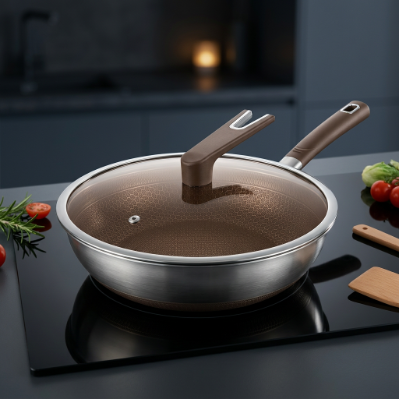
Not every frying pan works on an induction cooktop. A frying pan can be used on an induction cooktop if its base contains suitable magnetic material and meets the cooktop's requirements. That is why the answer for Household Frying Pans depends less on the pan's name and more on what the base is made of and how it is built.
This question matters to home cooks who are replacing a stove, and also to importers, wholesalers, and retailers who need to describe products accurately.
A gas burner heats a pan with flame. An electric radiant cooktop heats a glass or ceramic surface, and that surface passes heat to the pan. Induction works differently. A coil under the cooktop surface creates a changing magnetic field. When a pan with a suitable base sits on top, the field generates heat inside the base of the pan itself.
In practice, this means the cooktop surface is not the main heat source. The pan is. A pan that cannot respond to the magnetic field will not heat properly, and some cooktops will not switch on at all when they cannot detect cookware.
The magnetic field acts on the part of the pan closest to the coil, which is the base. A pan may have a stainless steel body or an aluminum body, but what counts is whether the base layer reacts to the field.
This is why looking at the body material alone is not enough. Two pans that look alike can behave differently on induction because of how their bases are made. Checking the base gives a more reliable answer than judging by appearance or by the material named in a product title.
| Frying Pan Type | Induction Compatibility | What to Check |
|---|---|---|
| Stainless Steel Frying Pan | Depends on the steel and base construction | Confirm that the base is magnetic |
| Cast Iron Frying Pan | Generally compatible | Check base flatness and handling weight |
| Carbon Steel Frying Pan | Generally compatible | Check the base condition and cookware instructions |
| Aluminum Frying Pan | Requires a suitable magnetic base | Verify induction compatibility |
| Nonstick Frying Pan | Depends on its base construction | Check the magnetic base rather than the coating alone |
| Copper Frying Pan | Usually requires a magnetic base layer | Confirm the manufacturer's compatibility information |
Stainless steel is a broad category. Some grades respond to a magnetic field and some do not. Many stainless steel frying pans made for induction include a magnetic layer or plate in the base to solve this.
So a stainless steel pan should not be treated as a yes or a no by default. Look for a magnetic base and for a clear induction statement from the maker.
Cast iron and carbon steel are both magnetic, so they usually work on induction cooktops. That makes them familiar choices for cooks who sear or brown food.
A few practical points still apply:
Aluminum is not magnetic. A plain aluminum pan will not heat on an induction cooktop. Many aluminum and nonstick pans are made to work on induction by adding a magnetic plate or a bonded magnetic base.
The nonstick coating has no effect on induction compatibility. It only affects the cooking surface. A pan can be nonstick and induction-ready, nonstick and not induction-ready, or the reverse. The base is what decides.
You do not need special equipment to get a useful answer. Two simple checks cover most situations.
Hold a small household magnet against the outside of the pan base. If it holds firmly, the base likely contains magnetic material.
This test has limits. A magnet that sticks is a good sign, but it does not guarantee even heating or reliable detection by every cooktop. Some pans have a magnetic plate that covers only part of the base. Others use a thin layer that holds a magnet but responds weakly. Treat the result as a first check, not a final one.
Many induction-ready pans carry a coil-shaped symbol on the base or on the packaging. Product pages, labels, and instruction sheets often state compatibility in plain words.
When the information is missing or unclear, ask the manufacturer. A clear answer about the base structure is more useful than a general claim that a pan is "suitable for all cooktops."
Compatibility gets a pan onto the cooktop. Daily use depends on a few other details.
A flat base keeps full contact with the cooktop surface. A warped base can sit unevenly, which may affect how the cooktop detects the pan and how heat spreads.
Size also counts. Induction cooktops heat a defined zone, and a pan much smaller than that zone may heat poorly or fail to register. Matching the pan base to the cooking zone helps the pan behave as expected.
How far the magnetic material extends across the base can influence detection and heating. A base that covers a wider area generally gives the cooktop more to work with than a small central disc.
Layered bases can also change how heat moves from the center to the edges. Two pans of the same size and material can feel different at the stove because of this. Testing samples under the same conditions gives a fairer comparison than reading descriptions alone.
A few daily details are worth a quick look:
For importers, wholesalers, and retailers, induction compatibility is a product information issue as much as a design issue. A listing that is vague can lead to returns and customer questions.
Cooktop types differ between markets. In some regions induction is common in new homes, while in others gas is still the usual choice. Preferred materials and pan sizes vary too.
Reviewing the target market first helps buyers decide how many induction-ready models to carry and which sizes and surfaces to include. Many ranges mix both, so that customers with different stoves can find a suitable pan.
Before ordering, ask the manufacturer to confirm these points in writing:
Samples are useful here. A short trial on a real induction cooktop can reveal issues that a specification sheet does not show.
Compatibility should hold across a full production run, not only in the sample. Ask how the manufacturer checks base flatness and magnetic response during production.
Packaging and instructions deserve the same attention. Care notes, cooktop information, and symbols should be accurate and easy to read. Clear labeling helps customers choose correctly and reduces confusion after purchase.
No. The coating does not decide compatibility. A nonstick pan works on induction only if its base contains suitable magnetic material.
Some can. It depends on the steel grade and on whether the base includes a magnetic layer. Check the product information to confirm.
Hold a small magnet against the outside of the base. If it holds firmly, the base likely has magnetic material. This is a quick check and does not guarantee heating performance.
In many cases, yes. Pans with magnetic bases are often used on gas and electric cooktops as well. Follow the manufacturer's instructions for each heat source, and keep handles away from direct flame.
Material is only the starting point. A pan that suits an induction cooktop needs a magnetic base, a construction that suits the cooking zone, and a flat surface that makes good contact. The coating, the body material, and the product name tell only part of the story.
For buyers choosing Household Frying Pans, the practical step is to confirm base structure, intended cooktops, and labeling before ordering, and to test samples where possible. With that information in hand, it becomes much easier to build a range that fits the stoves your customers use.
Recommended Products


NEWDREAM: +86 13646697735
HUANGXUKITCHENWARE: +86 19557954954


Donggao Fenghuangshan Industrial Zone, Tongqin Town, Wuyi County, Jinhua City, Zhejiang Province, China
Copyright © Wuyi Huangxu Industry & Trade Co., Ltd. All Rights Reserved.
Cookware Factory

 English
 русский
 日本語
 Español
 Deutsch