Inquiry
2026-10-23
A pan used for weekday breakfast doesn't need the same features as one used for searing steak or cooking a big family dinner. Some cooks want eggs to slide out cleanly. Others care more about a pan that keeps its heat when browning meat or vegetables. That is why Household Frying Pans come in so many shapes, materials, and surface finishes.
For cookware buyers, appearance only tells part of the story. A pan has to match how people cook, what kind of stove they own, and how much upkeep they are willing to do. The same questions apply to importers, wholesalers, and retailers who build product ranges for different customer groups.
So which designs deserve a place on the list? That depends on what goes into the pan and how it is used.
Picture an ordinary day in the kitchen. Breakfast may be eggs or pancakes, lunch a quick vegetable stir-fry, and dinner a browned piece of meat or a dish with sauce. Each of these puts different demands on the cookware.
Three points make a practical starting framework:
Looking at these first gives buyers a clearer basis for comparison than photos alone. It also helps manufacturers see which features matter to which customers.
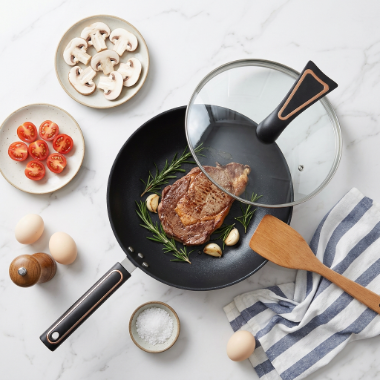
Materials and shapes each have their own strengths. No single design covers every recipe, so it helps to start from the task.
| Cooking Task | Pan Type to Consider | What to Check |
|---|---|---|
| Eggs and omelets | Nonstick frying pan | Food release, coating care, cleaning |
| Pancakes and crepes | Shallow frying pan | Low sides, room for turning |
| Meat and poultry | Stainless steel or cast iron pan | Heat response, browning |
| Fish and delicate ingredients | Nonstick or suitable stainless steel pan | Surface condition, ease of handling |
| Vegetables and mixed meals | Deep frying pan | Side height, room for stirring |
| Dishes with sauces | Deep-sided frying pan | Cooking space, liquid control |
Eggs show clearly why the surface matters. If food won't release, an omelet tears when you turn it, and cleanup takes longer than it should.
A nonstick frying pan can make these jobs easier when the coating is intact and the pan is used as the care instructions describe. It suits households that cook quick meals and like simple cleanup.
Coatings differ, though, and they don't share the same heat limits or care rules. High heat, abrasive cleaners, and metal utensils can damage some surfaces.
For wholesalers and retailers, this type serves customers who value convenience. When reviewing a product, check the coating details, recommended cooking conditions, handle construction, and cleaning guidance. The "nonstick" label alone says little.
A thin pancake is easier to turn when a spatula can slide under it without hitting a high wall. The same goes for crepes and fried eggs.
A shallow frying pan gives the spatula more room and works well for recipes where food is flipped or slid onto a plate. Handle comfort matters here too, since the pan is often tilted or turned while cooking. Surface condition affects how easily delicate food comes free.
In a product range, shallow pans sit comfortably beside standard models. They have a clear job, and customers don't need to learn a new technique to use them.
Stainless steel frying pans are a common choice for browning meat, poultry, and vegetables. They also leave behind browned bits on the surface, which cooks often use as the base for a pan sauce.
There is a learning curve. Food can stick if the pan isn't preheated properly, if the temperature is off, or if ingredients are moved before they release on their own. Preheating and the choice of cooking fat should follow the guidance for the specific pan and recipe.
This style suits cooks who enjoy searing and don't mind paying a little more attention at the stove. Buyers should look past the material name. The stated steel grade, base construction, handle attachment, and cooktop compatibility all show how the pan is meant to be used.
Cast iron is popular for searing and browning because it holds heat well. It usually takes longer to heat up and cool down than lighter cookware.
That changes how it feels in use. A cook who wants a steady surface may like it. Someone who often lifts and moves the pan mid-recipe may find it heavy.
Care is part of the picture as well. Some cast iron pans need seasoning, and they should be dried properly to reduce the risk of rust. Clear information on handling, seasoning, cleaning, and storage helps customers know what to expect, and it gives distributors a distinct product to offer. Casting is also a specialty of Wuyi Huangxu, which produces cookware through its own casting and machining facilities.
A shallow pan can feel crowded when several ingredients go in together. Vegetables, sliced meat, noodles, and sauce need room to be stirred without spilling.
Deep frying pans have taller sides, which suits mixed meals and recipes with liquid. A deeper shape doesn't fit every task, though. The cooking surface still has to hold the food, and the pan should stay manageable when full.
For retailers, deep-sided models give customers the option to cook different dishes in one pan. They work alongside shallow and standard pans rather than replacing them.
A pan can suit a recipe and still be a poor match for the stove in a given kitchen. Check cooktop compatibility before buying.
On a gas cooktop, the flame heats the pan from below. The flame should match the size of the pan base and not wrap far up the sides. Keep the handle away from direct flame where possible. Base stability and the manufacturer's usage guidance are worth checking.
Smooth cooktops work best with flat-bottomed pans that stay in full contact with the surface. A warped or uneven base sits poorly and can heat unevenly. When evaluating samples, check base flatness and stability. The product instructions should also explain precautions for sudden temperature changes.
Induction cooking needs a magnetic base. A plain aluminum pan, for example, won't work on induction unless its construction includes a suitable induction-compatible base. Don't judge compatibility by looks or by the material name. Confirm it with the manufacturer's stated specifications before ordering. Accurate cooktop information also helps with product listings and customer support.
Material and shape get most of the attention, but daily handling often comes down to smaller details.
A handle should give a secure, comfortable grip. Its shape, attachment, and position affect how easily the pan can be lifted, tilted, and moved.
Weight distribution counts too. A pan that feels fine empty can feel different once it is full. Larger pans may benefit from a helper handle. If a product is described as oven-safe, check the stated temperature limits for both the pan and the handle, since materials differ.
The base determines how the pan sits on the cooktop and how heat spreads through it. Two pans made from the same general material can heat differently because of their construction. When reviewing samples, check that the base sits flat and stays stable. If heating performance matters for your market, consistent testing under set conditions tells you more than appearance.
Some people want a surface they can simply wipe clean. Others are fine with a more involved routine. Storage matters too. Deep pans, detachable handles, and stackable designs can save cabinet space, depending on the product.
These details rarely show up in a product photo, but they shape everyday use.
For manufacturers, importers, and distributors, the hard part is deciding which products belong together. Several near-identical pans add little unless each has a clear purpose.
One way to organize a range is by cooking habit:
This structure makes products easier to compare and gaps easier to spot.
Local conditions matter as well. Cooking habits, preferred materials, storage space, and common cooktop types vary between regions, and a product that suits one customer group may not suit another.
Before placing an order, confirm product specifications, the sample approval process, packaging requirements, inspection arrangements, and delivery schedule with the manufacturer. For custom branding or packaging, agree on those details before production starts.
Choosing Household Frying Pans gets easier once the cooking task is clear. Nonstick models suit many everyday meals, shallow pans help with delicate foods, stainless steel and cast iron take different approaches to browning, and deep-sided designs give mixed dishes more room.
For B2B buyers, the aim is to understand what customers cook, which features they value, and what the local market expects, not to stock every available design.
Wuyi Huangxu Industry & Trade Co., Ltd. is a cookware manufacturer that produces frying pans, woks, and cookware sets, and it offers custom options. Buyers can narrow their choices by discussing intended use, material preferences, cooktop compatibility, and packaging needs with the manufacturer directly.
A useful product range starts with real cooking habits. Once those are clear, comparing pan designs becomes much simpler.
Recommended Products


NEWDREAM: +86 13646697735
HUANGXUKITCHENWARE: +86 19557954954


Donggao Fenghuangshan Industrial Zone, Tongqin Town, Wuyi County, Jinhua City, Zhejiang Province, China
Copyright © Wuyi Huangxu Industry & Trade Co., Ltd. All Rights Reserved.
Cookware Factory

 English
 русский
 日本語
 Español
 Deutsch