Inquiry
2026-11-20
Weeknight dinners often mean a crowded stove: one pot for potatoes, another for vegetables, a pan for fish. A Stainless Steel Steaming Pot with several tiers replaces that arrangement with a single stack. Steam rises from one water base and cooks different ingredients in separate compartments, so a household can prepare protein, vegetables, and a starch from one burner.
Households often find that the stove, not the recipe, limits a weeknight meal. A stacked steamer addresses that limit, though it works well only when ingredients are prepared and placed with some thought.
The cookware usually has a bottom pot, removable perforated tiers, and a lid. Water heats in the base, steam rises through each compartment, and the lid keeps that steam circulating around the food. Unlike a saucepan, where food sits in liquid, a steamer cooks with moist heat alone. Foods that turn mushy or lose flavor when boiled, such as fish, broccoli, and dumplings, often suit this method.
Removable tiers allow adjustment. A small dinner for two may need only one or two levels, while a family meal may use all of them. The arrangement can change from day to day without changing the cookware.
Stainless steel tolerates regular exposure to moisture, wipes clean, and stays sturdy through repeated use. Its smooth surface does not hold onto food odors the way some porous materials can, so a pot used for fish on Monday can handle fruit buns on Tuesday.
Products still differ. Base thickness, handle attachment, lid fit, and finish all affect daily use, so the stated specifications deserve a close look rather than an assumption that all stainless pots are built alike.
Picture chicken, broccoli, carrots, and rice for a family dinner. Instead of four separate pots, ingredients go into compartments according to cooking time and moisture content.
| Steaming Area | Suitable Ingredients | Preparation Notes |
|---|---|---|
| Lower tier | Carrots, potatoes, chicken in a covered dish | Needs the longest cooking time |
| Middle tier | Broccoli, cauliflower, squash | Cut into even pieces |
| Upper tier | Fish in a dish, tofu, tender greens | Check early to avoid overcooking |
This layout is a starting point, not a fixed rule. Steam strength, piece size, and quantity change timing from one pot to another, and a few test runs with familiar foods teach more than any chart.
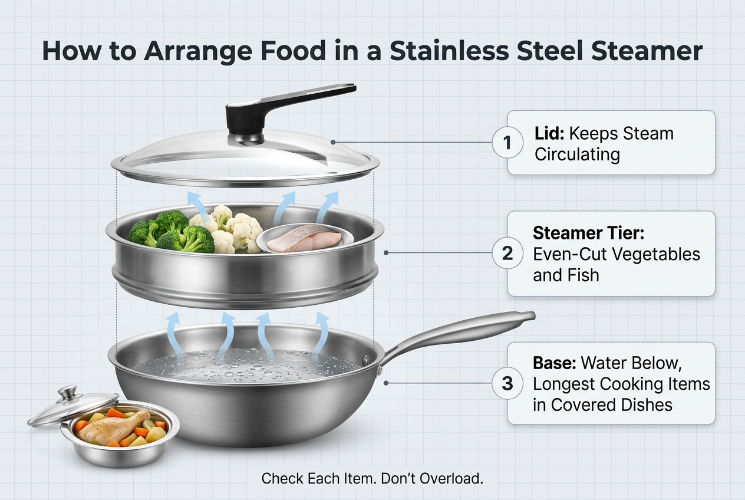
Raw meat and seafood should stay apart from food served without further cooking. Juices can drip downward, so place raw items in food-safe containers or on the lowest level, and cover ready-to-eat items.
Even pieces cook at a similar pace, so preparation affects results more than many cooks expect. A carrot sliced thick on one side and thin on the other will be raw in one bite and soft in the next.
Potatoes and thick chicken pieces need longer than leafy greens or a thin fish fillet. Start the slow items first, add quicker ones later, and lift out a tier once its contents are done. Check meat and seafood with a food thermometer instead of judging by appearance, since color alone can mislead.
When lifting a tier, use dry oven mitts. Escaping steam can burn skin quickly, so tilt the lid away from your face.
Compatible cooking needs matter more than cuisine. Some pairings suit a shared session:
Ginger, garlic, lemon, herbs, and light sauces add flavor without a separate cooking step. A spoonful of sesame oil or a squeeze of lemon after steaming often does more than heavy seasoning beforehand.
| Vegetable | Preparation | Cooking Note |
|---|---|---|
| Broccoli | Divide into florets | Avoid long steaming |
| Carrots | Slice evenly | Thick pieces need more time |
| Pumpkin | Cut into chunks | Test tenderness before serving |
| Green beans | Trim ends | Leave room for steam |
| Cauliflower | Separate into florets | Do not pack tightly |
| Corn | Cut into shorter sections | Allow room in the tier |
Dumplings and buns steam well when the tier has space and the recipe supports it. Lining the tier with parchment or cabbage leaves keeps dough from sticking to the holes. Rice needs a heatproof container with the right amount of water and cannot sit loose in a perforated tier.
Overlapping cooking periods save effort. Vegetables, protein, and a starch progress at the same time instead of one after another, which helps with weeknight dinners, packed lunches, and weekly meal preparation. Everything will not finish at the same moment, because timing depends on the ingredients.
One stack also reduces clutter. Fewer pots sit on the stove, fewer lids need washing, and removable tiers can be separated for cleaning and often nested for storage in a small kitchen.
Steaming needs no oil for cooking, so cooks keep control over added fat, salt, and sauces. Nutrition still depends on ingredient choice, portions, and seasoning. A plate of steamed vegetables drowned in a heavy sauce is a different meal from the same vegetables with herbs and lemon.
Reheating works too. Leftover rice, buns, or cooked vegetables regain moisture in a steamer, whereas a microwave can leave them dry at the edges.
Capacity should match the household. Consider how many people share meals, whether whole fish or large vegetables are cooked, and whether the assembled pot fits the stove and the kitchen cabinet.
| Configuration | Suited To | Consideration |
|---|---|---|
| Two-tier | Smaller meals, daily vegetables | Compact storage |
| Three-tier | Meals with several components | More arrangement flexibility |
| Expandable | Varying meal sizes | Check stability between parts |
A taller stack is not always better. It can feel top-heavy when full and may not fit under a range hood.
Look closely at construction:
Cooktop compatibility needs checking before purchase. Some pots suit gas only, while others also work with induction or electric surfaces. The manufacturer's instructions give the answer, and appearance does not.
Several habits cause uneven results or damage the cookware.
Storing tiers while still damp can leave water spots and musty smells. A few minutes of air drying before stacking avoids both.
A steaming pot earns its place when it fits the way a household cooks. Capacity, tier count, material details, handle and lid construction, cleaning needs, and cooktop compatibility are the points worth comparing before purchase.
Specifications for our Stainless Steel Steaming Pot range, including tier configurations and compatibility information, are available on request. The support team can assist with comparing sizes and features for specific kitchens and cooking routines.
Recommended Products


NEWDREAM: +86 13646697735
HUANGXUKITCHENWARE: +86 19557954954


Donggao Fenghuangshan Industrial Zone, Tongqin Town, Wuyi County, Jinhua City, Zhejiang Province, China
Copyright © Wuyi Huangxu Industry & Trade Co., Ltd. All Rights Reserved.
Cookware Factory

 English
 русский
 日本語
 Español
 Deutsch