Inquiry
2026-11-13
A Stainless Steel Pan for Frying and a nonstick pan can sit on the same stove and behave very differently. One builds a brown crust and leaves flavorful residue that becomes a sauce. The other lets a fried egg slide out with almost no effort. Neither surface suits every task, so the better fit depends on what a household cooks on an ordinary weeknight.
Food release, browning, cleaning, and wear show up quickly in daily use. Matching those traits to real meals avoids frustration and unnecessary purchases.
The cooking surface is the core difference. An uncoated stainless steel pan has a bare metal interior. A nonstick pan carries a coating that reduces contact between food and the metal underneath.
Stainless steel pans often use layered construction, with a heat-conductive core between steel layers. That structure spreads heat across the base and reduces hot spots, which matters when a steak is cooking and one edge keeps browning faster than the other. Such a pan suits searing, browning vegetables, building pan sauces, and moving a dish into the oven when the handle allows it.
Nonstick pans suit delicate foods. Eggs, pancakes, omelets, and thin fish fillets lift out without tearing. The coating needs careful handling, though. Metal utensils, abrasive sponges, and overheating can damage certain surfaces, and a scratched coating changes how food releases.
| Feature | Uncoated Stainless Steel | Nonstick |
|---|---|---|
| Food release | Depends on heat and oil control | Releases with less effort |
| Browning | Develops a deep crust | Gives lighter browning |
| High-heat cooking | Suits searing when construction allows | Needs attention to coating limits |
| Durability | Bare metal tolerates regular use | Coating may wear over time |
| Cleaning | May need soaking after searing | Usually quick after eggs |
| Utensils | Metal often acceptable, depending on finish | Soft or non-abrasive tools advised |
| Oil use | A thin layer usually helps | Can work with less |
Stainless steel rewards technique, while nonstick rewards convenience. Both are reasonable depending on the cook.
It can, and the cause is usually technique. Bare metal does not release food on its own, so heat, fat, and moisture all play a part. A pan that is too cold lets proteins grip the metal. A pan that is far too hot burns the oil and leaves a sticky film.
A dependable routine looks like this:
A chicken breast that clings at first often lets go once it browns. Prying it up early tears the surface and leaves a stuck layer that makes the next piece cling too. Patience for a minute or two usually solves the problem.
Wet ingredients cause trouble as well. Washed mushrooms or thawed fish release water that turns to steam and blocks browning, so blotting them dry before cooking helps.
Matching the pan to the ingredient makes daily cooking easier. A pan that sears beautifully may feel clumsy with a delicate omelet, and the reverse is also true.
Yes. Steak, chicken breast, and pork chops benefit from direct contact with hot metal. The browned bits left on the surface, often called fond, carry a lot of flavor. After removing the meat, pour in broth or water, loosen those bits with a spoon, and reduce the liquid into a simple sauce. Garlic butter sauce or a mushroom sauce comes from the same pan within minutes, with no extra cookware to wash.
A nonstick surface does not build and hold that residue in the same way, so the sauce step is less rewarding there.
On busy mornings, often yes. Eggs and pancakes release with little resistance, and cleanup takes seconds. Stainless steel can cook eggs well, but it needs lower heat, enough fat, and some patience while the whites set.
Mushrooms, onions, peppers, asparagus, and zucchini pick up browned edges in stainless steel. Soft vegetables that break apart easily may be simpler in a nonstick pan. Overcrowding causes steaming in either one, so cook in batches when the pan fills up.
| Food | Stainless Steel | Nonstick |
|---|---|---|
| Steak and chicken | Strong browning and pan sauce | Acceptable, with lighter crust |
| Eggs and omelets | Possible with careful heat control | Easy release |
| Pancakes | Needs practice | Convenient |
| Fish fillets | Works with dry fish and enough oil | Gentle on delicate fillets |
| Browned vegetables | Good edge color | Softer result |
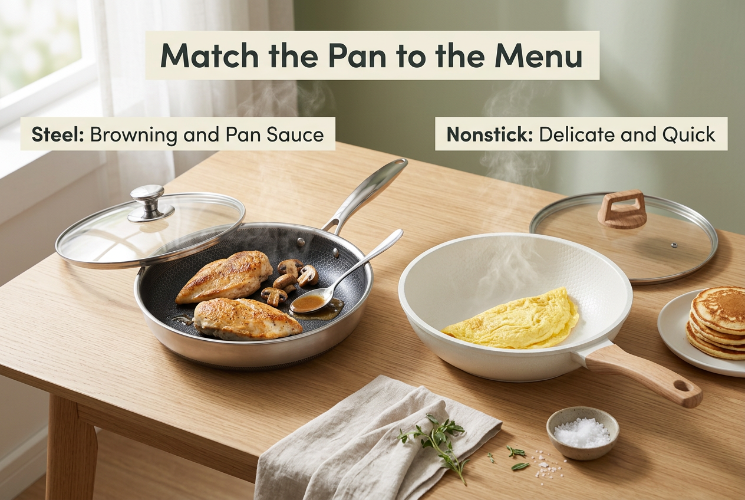
Choosing by the food on the menu works better than choosing by habit.
Understanding both sides prevents unrealistic expectations.
Cleaning is manageable. Let the pan cool, soak stuck-on food in warm water, wash with a non-abrasive sponge, and dry it to limit water spots. A stainless steel cleaner helps with stubborn marks or heat tint. Scratches and cosmetic marks appear over time but do not mean the pan has stopped working.
Nonstick pans have their own upkeep. Soft tools, gentle washing, and moderate heat protect the coating, and a worn coating eventually calls for replacement. Stainless steel does not depend on a coating that wears away.
Material name alone says little. Construction, size, handle, and cooktop compatibility shape daily use.
| Pan Size | Suitable Tasks |
|---|---|
| Small | Single portions, eggs, quick sides |
| Medium | Everyday meals, chicken portions, vegetables |
| Large | Bigger cuts of meat, family-style meals |
A pan that is too small crowds the food, and an oversized one takes more oil and storage space. A medium pan covers many weeknight meals for small households, while larger families may want a bigger pan for batch cooking.
Lift the pan in the shop if possible. A pan that feels balanced when empty may feel awkward when filled with food.
Many households keep both. A stainless steel pan handles searing, browning, and sauces, while a nonstick pan takes care of breakfast and fragile foods. Each pan then works on the tasks suited to its surface, and neither gets pushed past its strengths.
Cooks who sear often, make pan sauces, or prefer a bare metal surface will find a stainless steel frying pan a sensible fit. Those who mostly prepare eggs and pancakes may find a nonstick pan more convenient.
Information on construction, sizes, handles, and cooktop compatibility for our Stainless Steel Pan for Frying range is available on request. The support team can help match a pan to specific cooking habits and kitchen equipment.
Recommended Products


NEWDREAM: +86 13646697735
HUANGXUKITCHENWARE: +86 19557954954


Donggao Fenghuangshan Industrial Zone, Tongqin Town, Wuyi County, Jinhua City, Zhejiang Province, China
Copyright © Wuyi Huangxu Industry & Trade Co., Ltd. All Rights Reserved.
Cookware Factory

 English
 русский
 日本語
 Español
 Deutsch