Inquiry
2026-10-16
Walk into any kitchen supply aisle and you'll notice something: stainless steel pots and pans show up everywhere, from compact apartment kitchens to busy family households. That popularity isn't an accident. People keep coming back to this material because it holds up to daily cooking without demanding constant babysitting.
Stainless steel doesn't react with acidic ingredients like tomatoes or citrus the way some other metals do. That means your tomato sauce or lemon-based marinade won't pick up a metallic taste, and the pan itself won't corrode from regular contact with these foods. It also tends to shrug off scratches from metal spoons better than nonstick coatings, which is one reason households with kids or roommates often gravitate toward it.
Because stainless steel doesn't carry flavor between dishes, you can sear chicken one night and simmer a vegetable stew the next without worrying about lingering tastes. This flexibility is part of why it works as an everyday choice rather than a specialty item reserved for certain recipes.
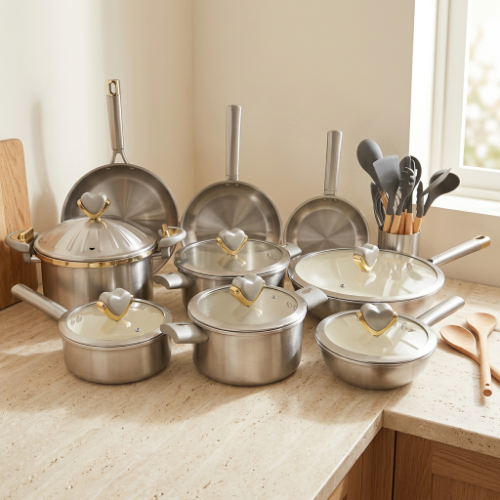
Choosing cookware isn't just about appearance. A few practical details end up mattering more once the set is in your kitchen for a few months.
Many stainless steel pieces include a core or base layer made of aluminum or copper sandwiched between stainless layers. This construction helps heat spread more evenly across the cooking surface, which reduces the chance of hot spots that scorch food in one area while leaving another part undercooked. When comparing sets, it helps to ask the supplier or read the product description for details on how the base is built, rather than assuming all stainless cookware behaves the same way on the stove.
A heavier pan isn't automatically a better one, and a lighter pan isn't automatically flimsy. What matters is whether the weight feels manageable for the way you cook. If you're frequently lifting a pan to toss vegetables or plate food directly from the skillet, a piece that feels unwieldy in your grip will wear on you over time, even if it performs fine on the stove.
A lid that sits loosely can let steam escape when you're trying to simmer rice or braise a cut of meat slowly. Handles matter too, especially if they're exposed to direct heat from a burner or oven. Riveted handles tend to stay secure longer than ones attached with adhesive or simple screws, and handles that stay cool to the touch make a noticeable difference during actual cooking rather than just when you're inspecting the set in a showroom.
Not every household needs the same combination of pots and pans. Someone who cooks mostly solo meals has different needs than a family that regularly prepares larger batches or hosts dinners. Here's a general breakdown to help think through it.
| Cooking Style | Pieces That Tend to Get Used Most | Pieces That Might Sit Unused |
|---|---|---|
| Solo or couple households | Small saucepan, one skillet, one stockpot | Extra-large stockpot, multiple skillet sizes |
| Family meals, regular cooking | Mixed skillet sizes, sauté pan, medium and large pots | Specialty pans like woks or griddles |
| Entertaining or batch cooking | Larger stockpots, stacked saucepans, steamer inserts | Small single-serving saucepans |
| Minimalist or small kitchen setups | Multi-purpose pan, one versatile pot | Full matching sets with many pieces |
A polished finish looks appealing on a store shelf, but it also shows water spots and fingerprints more readily than a brushed or satin finish. Neither option is inherently wrong, it's really about how much time you're willing to spend wiping down the exterior after use. Interior cooking surfaces will develop some discoloration from heat and food residue over time regardless of finish, and that's a normal part of using the cookware rather than a sign something has gone wrong.
If your kitchen uses an induction cooktop, double check that the cookware you're considering is actually compatible, since not all stainless steel contains enough magnetic material to work on induction surfaces. Gas and electric coil stoves are generally more forgiving, but it's still worth confirming before you commit to a purchase, especially if you're ordering online and can't test the pan in person first.
Set sizes range widely, and bigger isn't always more practical. Before deciding on a twelve-piece set versus a smaller bundle, think about what gets used in a typical week.
Buying a set with pieces you rarely touch doesn't save money in the long run, it just takes up storage space. If you already own a reliable skillet, for example, a set focused on pots and saucepans might make more sense than starting over with everything brand new.
Whether you're a home cook comparing options online or a buyer sourcing cookware for resale, a few straightforward questions can clear up a lot of confusion:
Getting clear answers to these questions upfront tends to prevent disappointment after the cookware arrives.
Letting a hot pan cool gradually before running it under cold water helps avoid warping over time. Using wooden, silicone, or plastic utensils instead of metal ones can reduce surface scratching, even though stainless steel handles metal utensils better than most nonstick surfaces do. Drying pots and pans thoroughly after washing, rather than letting them air dry with water pooling on the surface, helps prevent water spots and mineral buildup.
Stacking pots without any protective layer between them can lead to scratching on the exterior finish. Using high heat for extended periods when a lower setting would do the job can also discolor the interior surface faster than normal use would. And running stainless cookware through a dishwasher regularly, even when it's labeled as dishwasher safe, can gradually dull the finish compared to hand washing.
Picking a stainless steel cooking set for everyday use really comes down to matching the cookware to how you actually cook, not just how a set looks in photos or how many pieces come bundled together. Paying attention to construction, handle design, stovetop compatibility, and realistic piece count will steer you toward a set that fits your kitchen rather than one that just fits a marketing bundle. A little research before buying tends to save both money and frustration down the road, and it makes the whole process of cooking dinner feel a lot less like a chore and more like something you can rely on, day after day.
Recommended Products


NEWDREAM: +86 13646697735
HUANGXUKITCHENWARE: +86 19557954954


Donggao Fenghuangshan Industrial Zone, Tongqin Town, Wuyi County, Jinhua City, Zhejiang Province, China
Copyright © Wuyi Huangxu Industry & Trade Co., Ltd. All Rights Reserved.
Cookware Factory

 English
 русский
 日本語
日本語 Español
 Deutsch