Inquiry
2026-11-27
Uneven results on a steaming tray are a common observation in home and commercial kitchens. Dumplings near the wall may turn soft and glossy while those in the middle remain doughy, and fish can be cooked at the edges but underdone beneath. In a Stainless Steel Steaming Pot, the perforated tray determines where steam can pass, and the way food is loaded determines whether it actually does.
The size, spacing, and layout of the openings interact with the pot body, the lid, the base, and the ingredients themselves. Examining each factor explains why two pots of similar capacity can perform differently in daily use.
Water heats in the lower section of the pot, and steam rises through the tray openings to reach the food above. Boiling places food in hot water. Steaming relies on moving vapor that surrounds the ingredients and transfers heat to their surfaces. The tray therefore has to leave enough open space for vapor to travel without obstruction.
Steam moves toward whatever openings are available. A flat plate covering most of the holes leaves few routes, and a layer of leafy greens pressed across the surface has a similar effect. Areas with limited steam access heat more slowly, so the top of a portion may soften while the underside, which rests against the tray, stays firm.
Four conditions shape this movement:
A steaming pot works as a small system made up of pot, tray, lid, and loading habits. Evaluating only the metal container overlooks most of what affects the result.
Size and spacing work together. Neither one explains performance alone, and changing one often requires adjusting the other.
Small holes support delicate items such as dumplings, rice rolls, and small pieces of tofu, because the food rests on more metal and is less likely to sag or slip through. Very small openings, however, restrict the amount of steam that passes at each point.
Larger holes open wider pathways. Small pieces such as peas, diced vegetables, or broken dumpling wrappers can then drop through or wedge in the openings, which makes cleaning harder. A tray intended for mixed daily use usually needs a compromise that suits both delicate and bulky foods.
The relationship between hole diameter and typical ingredient size is worth considering before purchase. A household that steams buns and fish fillets has different needs from one that steams small shellfish or chopped vegetables.
Consistent spacing carries steam pathways across the whole tray. When holes are grouped in one zone and sparse elsewhere, the sparse zones receive less steam, and food placed there may lag behind the rest.
Spacing also affects strength. A tray needs enough solid metal between openings to hold a whole fish, a plate of dumplings, or a load of potatoes without bending. Repeated loading and washing will expose weak designs over time.
Not automatically. A tray with many openings can still distribute steam poorly if the holes are badly arranged, and oversized openings reduce food support. Hole quantity says little unless size, spacing, and layout are considered together.
| Design Feature | Potential Benefit | Consideration |
|---|---|---|
| Smaller holes | Support for small ingredients | Steam passage must stay accessible |
| Larger holes | Wider steam pathways | Food support needs attention |
| Even spacing | Consistent distribution across the tray | Tray strength must be maintained |
| Clustered openings | More open space in selected areas | Other areas may receive less steam |
| Balanced layout | Combines steam access and support | Match to food size and loading |
Reading across the rows shows that each feature solves one problem while creating another. The practical question is which compromise suits the foods cooked most often.
Even hole placement does not guarantee even heating. Water temperature, steam output, pot shape, lid fit, and food arrangement all contribute to the result.
The center of a tray tends to fill first, since cooks naturally pile food there. A crowd of ingredients blocks the steam rising beneath it. Near the edges, the gap between the food and the pot wall changes how steam travels. Dumplings placed near the wall may cook sooner than those packed in the middle, particularly when the lid is heated unevenly.
Several habits reduce the difference:
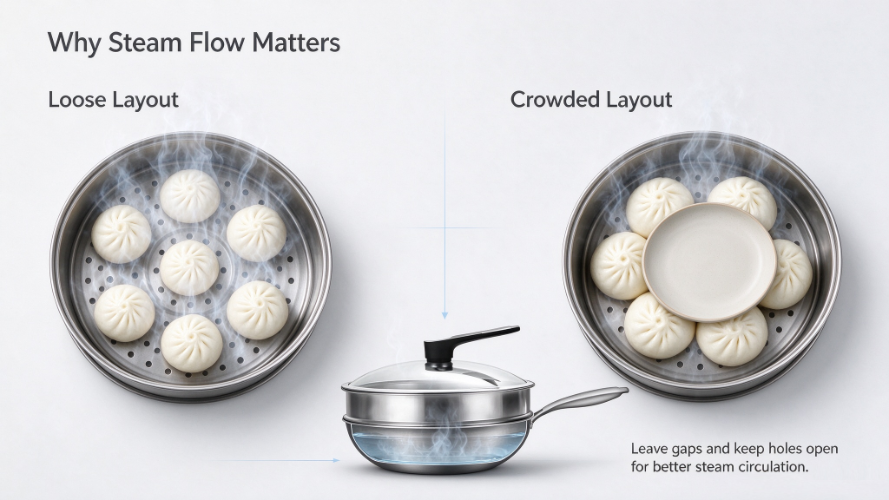
Food type also changes how the tray should be loaded.
| Food Type | Suggested Arrangement | Cooking Note |
|---|---|---|
| Leafy vegetables | Loose layer | Avoid compressing the leaves |
| Dumplings | Space between pieces | Keep pathways open |
| Fish | Stable dish or lined surface | Do not block surrounding holes |
| Root vegetables | Separated pieces | Steam reaches each cut surface |
| Seafood | Single layer where possible | Avoid heavy stacking |
Lining the tray with punched parchment or cabbage leaves stops dough from sticking without sealing the openings. Solid liners with no perforations defeat the purpose of the tray.
The tray cannot compensate for a weak base or a poorly fitting lid. Other parts of the pot carry equal weight.
Stainless steel tolerates moisture, cleans easily, and holds its shape through regular use. Steel grade, thickness, and finish vary between products, so the stated specifications deserve attention instead of an assumption that all stainless pots are the same.
The base receives heat from the burner and passes it to the water. It should sit flat and match the cooktop, whether gas, electric, or induction. Uneven contact leads to inconsistent steam production, and the best tray layout cannot correct that.
Extra tiers add cooking space but lengthen the path steam must travel. Check that trays fit securely, that spacing allows steam to reach each level, and that the stack remains stable when full. Filling every level to capacity slows circulation, so leave room around the food.
Mineral deposits from hard water can also narrow small holes over time. Cleaning according to the manufacturer's instructions keeps the openings clear.
Handling the product in person, or studying detailed photographs, reveals more than a feature list.
| Purchasing Factor | What to Examine | Why It Matters |
|---|---|---|
| Tray openings | Size and arrangement | Defines steam pathways |
| Material | Steel grade and finish | Affects durability and cleaning |
| Capacity | Internal cooking space | Determines loading |
| Tier structure | Spacing and stability | Affects multi-level cooking |
| Pot base | Cooktop compatibility | Supports steady heating |
| Lid | Fit and handle | Helps retain steam |
Press lightly on the tray to see whether it flexes. Check that it sits level in the pot, that edges are smooth, and that holes are distributed across the whole usable surface. Think about the foods cooked most often. A household that steams dumplings and buns needs different tray support from one that mostly cooks fish and vegetables.
Information on tray layouts, tier configurations, and material specifications for our Stainless Steel Steaming Pot range is available on request. The support team can discuss household or commercial requirements and help match them to suitable designs.
Recommended Products


NEWDREAM: +86 13646697735
HUANGXUKITCHENWARE: +86 19557954954


Donggao Fenghuangshan Industrial Zone, Tongqin Town, Wuyi County, Jinhua City, Zhejiang Province, China
Copyright © Wuyi Huangxu Industry & Trade Co., Ltd. All Rights Reserved.
Cookware Factory

 English
 русский
 日本語
 Español
 Deutsch