Inquiry
2026-03-06
The thermal performance of any household frying pan depends heavily on the metals chosen during manufacturing. Aluminum alloys remain the most common base material due to thermal conductivity that spreads heat rapidly across the entire cooking surface without creating hot spots that burn food. Stainless steel grades offer superior corrosion resistance and durability, though their natural heat distribution characteristics require engineering solutions like encapsulated bases or multi-layer construction to achieve uniform cooking temperatures. Copper cores appear in premium cookware where maximum thermal responsiveness justifies higher cost, though they require protective linings to prevent metal migration into food.
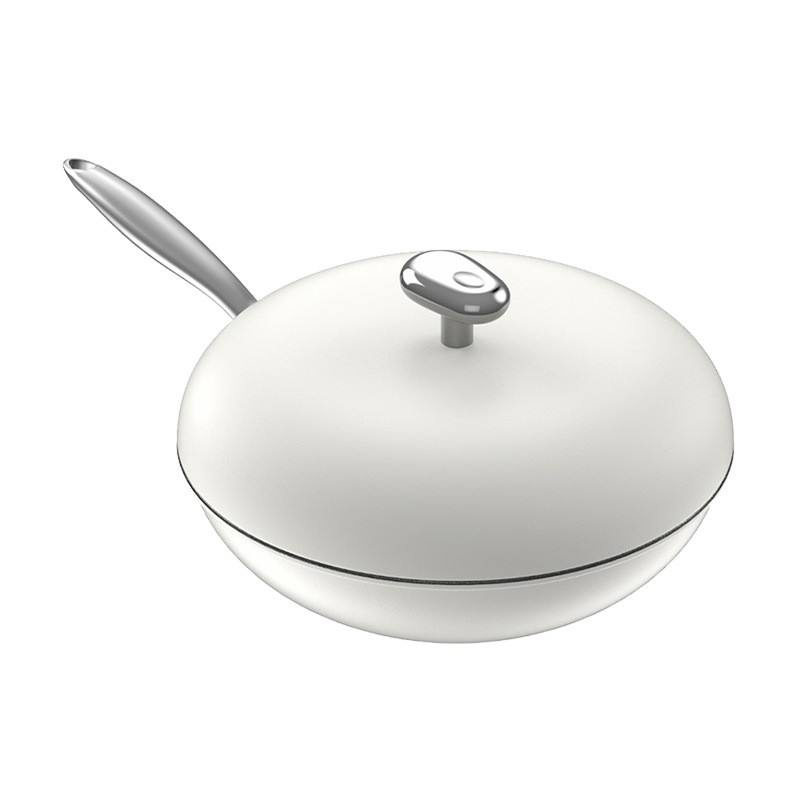
The manufacturing journey begins with circular discs stamped from rolled aluminum sheet of specific thickness determined by pan diameter and intended use. Blanking operations cut discs from sheet stock with dimensional accuracy, ensuring consistent material volume for forming. Flow-forming machines with computer-controlled rollers gradually shape the sidewalls while maintaining uniform material thickness throughout curved surfaces. Trimming stations remove excess material and create precise rim profiles ready for edge finishing operations. A quality household frying pan from automated production lines maintains uniform wall thickness to prevent uneven heating that would otherwise create frustrating cooking results for home users.
Fluoropolymer coating systems require careful surface preparation before application. Grit blasting creates microscopic anchor profiles in aluminum substrates that promote mechanical adhesion of primer layers. Primer application deposits modified polymer formulations containing binders that establish base adhesion to prepared metal surfaces. Topcoat spraying applies release layers through precision equipment, controlling thickness within narrow ranges. Curing ovens with controlled temperature profiles transform liquid coatings into durable, release-friendly solid films. A properly coated household frying pan withstands years of regular use without significant degradation when maintained according to manufacturer recommendations and cleaning guidelines.
Handle attachment represents a critical design consideration affecting both safety and durability. Several methods address the competing requirements of strength, appearance, and thermal management:
Finished cookware undergoes various verification steps before reaching consumers. Flatness verification ensures proper contact with cooking surfaces, particularly important for induction compatibility, where gaps reduce heating efficiency. Adhesion testing confirms coating systems bond properly to substrates through cross-hatch and tape pull methods. Thermal cycling evaluation assesses how pans respond to repeated heating and cooling without warping or coating degradation. Abrasion resistance testing simulates years of utensil contact to verify coating durability. A certified household frying pan meets these performance criteria consistently across production batches, providing reliable service throughout the expected product lifespan.
Handling temperature during cooking represents a primary safety concern addressed through engineering. Thermal barriers interrupt heat paths between the pan body and the gripping areas. Insulating materials with low thermal conductivity protect hands from conducted heat. Strategic air gaps create convection breaks, reducing heat transfer to handles. Stable base geometries with appropriate diameter-to-height ratios prevent tipping accidents that could cause burns or kitchen fires. These safety features integrate intothe overall design rather than appearing as afterthoughts, reflecting comprehensive engineering approaches.
Modern kitchen electrification trends drive demand for induction-compatible cookware. Ferromagnetic materials in base construction respond to magnetic fields generated by induction coils, converting electromagnetic energy directly to heat. Multi-layer constructions incorporate stainless steel grades with sufficient magnetic permeability while maintaining aluminum cores essential for heat distribution. Base flatness tolerances ensure consistent contact with glass cooktop surfaces for efficient energy transfer. A versatile household frying pan accommodates multiple cooktop types through thoughtful material engineering that considers how different heat sources interact with pan design.
Recommended Products


NEWDREAM: +86 13646697735
HUANGXUKITCHENWARE: +86 19557954954


Donggao Fenghuangshan Industrial Zone, Tongqin Town, Wuyi County, Jinhua City, Zhejiang Province, China
Copyright © Wuyi Huangxu Industry & Trade Co., Ltd. All Rights Reserved.
Cookware Factory

 English
 русский
 日本語
日本語 Español
 Deutsch