Inquiry
2026-10-02
A weeknight dinner rarely leaves much room for extra kitchen tasks. Food goes in the pan, gets plated, and the pan itself usually sits waiting until the rest of the meal is handled. What happens to that pan in the next few minutes — whether it cools first, what kind of sponge touches it, how hard someone scrubs at a stuck spot — quietly decides how long the nonstick surface keeps working the way it did on day one.
A stainless steel nonstick frying pan relies on a thin coating bonded to the metal underneath. That coating responds to heat, water, and contact very differently than the bare steel body around it. Treating the whole pan the same way during cleanup, the way someone might scrub a cast iron skillet or a plain stainless pot, tends to wear the coating down faster than regular cooking ever would.
The good news is that keeping the surface in decent shape doesn't call for special products or extra time. It mostly comes down to a handful of habits repeated consistently. A few things worth keeping in mind before diving into the routine itself:
A stainless steel nonstick frying pan is built in layers — a steel body for heat conduction and structure, with a nonstick coating applied over the cooking surface. That coating is where all the cleaning caution actually applies. The steel exterior and handle can handle fairly normal treatment, but the interior cooking surface behaves more like a delicate finish than a rugged metal one.
Because the coating is thin, damage doesn't usually happen from one rough scrub. It accumulates. A metal spatula scraping the edge here, a scouring pad pressed a bit too hard there — none of it looks like much in the moment, but repeated over weeks and months, those small marks add up to a surface that no longer releases food the way it used to.
This is really the core difference between cleaning this type of pan and cleaning plain stainless steel or cast iron. With bare metal, aggressive scrubbing is often the fix. With a nonstick coating, aggressive scrubbing is usually the problem.
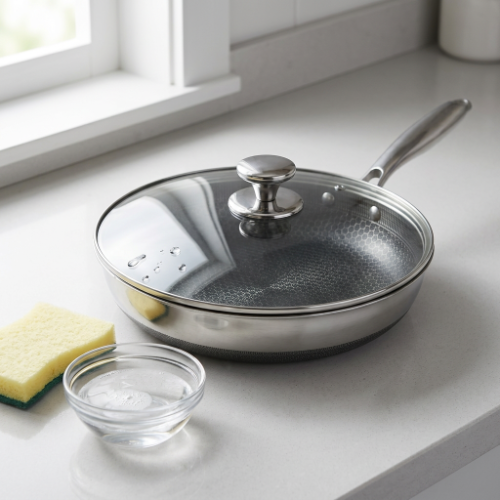
Right after cooking, a pan is often still hot enough to sizzle if water touches it. Rinsing it immediately under cold water at that point creates a fast temperature drop across the metal and coating together. That kind of thermal shock, repeated often enough, can loosen the bond between the coating and the steel base underneath.
Letting the pan sit for a few minutes off the heat solves this without adding much delay to cleanup. It doesn't need to cool completely, just enough that cold water doesn't cause a sharp temperature swing on contact.
Water temperature during washing matters too. Warm water dissolves oil residue more easily than cold water, which means less scrubbing is needed to get the surface clean. Less scrubbing translates fairly directly into less wear on the coating over time.
A basic routine, done consistently, covers most of what the coating needs after regular use.
The drying step gets skipped more often than people realize, mostly because it feels unnecessary. But air drying leaves mineral deposits from tap water sitting on the surface as it evaporates, which is where a lot of those faint white spots or cloudy patches come from over time. A quick towel dry avoids that step entirely.
Not every mark on a nonstick surface means something is wrong with the pan. Most common issues trace back to specific causes, and most have a fix that doesn't involve scrubbing harder.
| Issue | Likely Cause | Suggested Fix |
|---|---|---|
| Rainbow colored patches | Overheating or mineral content in tap water | Wipe with a diluted vinegar and water mix, rinse and dry |
| Sticky film after washing | Leftover oil or soap not fully rinsed | Rewash with warm water, rinse twice before drying |
| Burnt residue on the surface | High heat cooking without enough oil | Soak in warm water briefly, then wipe with a soft sponge |
| Cloudy white spots | Mineral deposits from air drying | Wipe with diluted vinegar, dry fully by hand |
Soaking tends to be the underrated step in most of these fixes. Giving stubborn residue a few extra minutes in warm water almost always reduces the scrubbing needed afterward, which protects the coating without adding real effort to the process.
Some stainless steel nonstick frying pans are labeled as dishwasher safe, which is technically accurate but doesn't tell the whole story. Dishwasher detergents run stronger than typical hand soap, and the heat cycles combined with contact against other dishes and utensils can wear down a nonstick coating faster than routine hand washing would.
Using the dishwasher occasionally, for a busy week or a stack of dishes after a larger meal, isn't likely to cause noticeable damage on its own. Making it the regular method, though, tends to shorten how long the coating performs well, particularly compared with a consistent hand washing routine using a soft sponge and mild soap.
Cleaning technique covers part of the picture, but a few habits outside of washing time matter just as much for how the coating holds up.
Storage habits get overlooked more often than cooking habits, mostly because the damage happens quietly in a cabinet rather than at the stove. Pans stacked directly on top of each other, sliding slightly every time the cabinet opens, pick up scratches over months that have nothing to do with cooking at all.
A quick visual check, done every so often rather than every single time, helps catch early signs of wear before they turn into bigger issues.
None of these checks take more than a minute, and catching a small issue early — a patch that's starting to lose its nonstick quality, for instance — makes it easier to adjust cooking habits before the coating wears down further.
How a stainless steel nonstick frying pan performs after a year or two depends far more on cleaning habits than on the cooking itself. Searing, frying, and simmering are exactly what the pan is built for. What actually shortens its useful life is usually what happens in the sink afterward — cold water on a hot surface, a scouring pad reaching for stuck food, air drying left to run its course.
None of these habits require much effort to fix, which is really the point. A few extra minutes of patience during cleanup, paired with gentle tools and proper drying, tend to keep a Stainless Steel Nonstick Frying Pan performing close to how it did on day one, meal after meal, without adding complexity to an already busy kitchen routine.
Recommended Products


NEWDREAM: +86 13646697735
HUANGXUKITCHENWARE: +86 19557954954


Donggao Fenghuangshan Industrial Zone, Tongqin Town, Wuyi County, Jinhua City, Zhejiang Province, China
Copyright © Wuyi Huangxu Industry & Trade Co., Ltd. All Rights Reserved.
Cookware Factory

 English
 русский
 日本語
日本語 Español
 Deutsch